

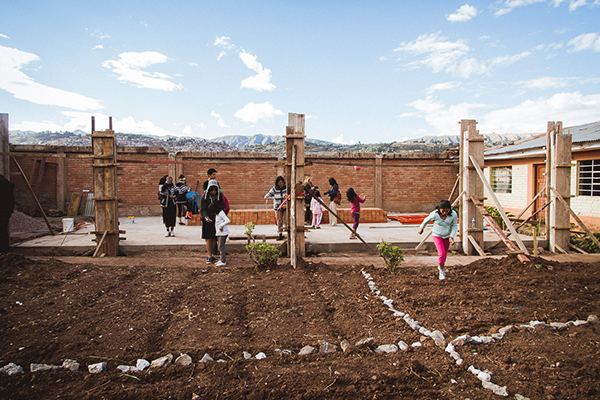
What Is Community Infrastructure? Examples & Impact
Think about the last time you walked to school, filled a water bottle or met friends at a park. Each of those moments depended on community infrastructure: a sidewalk, a water line, a public space. Most of the time, we only notice it when it's missing.
It's the network of physical places and systems that make neighborhood life possible, from paths and water connections to schools, clinics and parks. In this article, you will learn what community infrastructure means, the main types and how they work together, real examples from communities in Peru and Ecuador and how students can take part in building it alongside local professionals.
What is community infrastructure?
Community infrastructure refers to the facilities and systems that serve a neighborhood or local area and support everyday life, health, learning and connection. It's different from large-scale infrastructure like highways or power plants because it's close to people and shaped by their daily needs. It's also where gaps are felt most directly: a missing staircase or water connection changes a family's routine every single day.
Physical and social infrastructure
Researchers often describe two overlapping layers:
- Physical infrastructure: paths, stairs, water and sanitation systems, drainage and energy
- Social infrastructure: the shared places where people meet and support each other, such as schools, libraries, parks and community centers
Geographers Alan Latham and Jack Layton describe social infrastructure as the networks of spaces and facilities that shape how people interact in public life. In practice, the two layers depend on each other: a community center is only useful if people can safely reach it.
Types of community infrastructure
| Type | Examples | Why it matters |
|---|---|---|
| Access and mobility | Staircases, footpaths, handrails | Safe routes to school, work and health care |
| Water and sanitation | Water connections, storage, bathrooms | Health, hygiene and time saved |
| Safety and stability | Retaining walls, drainage | Protection from slides and erosion |
| Education | Classrooms, school bathrooms | Healthier, safer learning spaces |
| Food and environment | Greenhouses, gardens | Food security and nutrition |
| Public and social space | Parks, playgrounds, community centers | Connection, play and organization |
How the types work together
Community infrastructure is a system. A new classroom helps more when children can reach it on a safe staircase. A greenhouse helps more when families have water nearby. That's why community priorities, not a single project type, should guide what gets built first. Residents know which gaps cost them the most time, money and safety each day, and their input helps make sure each new project connects to what already exists.
Community infrastructure examples from Peru and Ecuador
Staircases and retaining walls in Lima
In hillside neighborhoods around Lima, many paths are steep dirt slopes. Concrete staircases and retaining walls create safer routes and help hold unstable ground in place. Our guide to the top volunteer projects in Lima describes the kinds of projects communities choose.
School renovations
Renovating classrooms, bathrooms and shared spaces helps students learn in safer, healthier conditions, and it often turns a school into a gathering point for the whole neighborhood. See how a school renovation project in Lima came together.
Greenhouses in Cusco
In the highlands around Cusco, greenhouses help families grow food in a cold, high-altitude climate, extending what they can harvest close to home. Learn about the purpose of greenhouse projects and their impact.
How students help build community infrastructure
Safe Homes Movement, powered by MEDLIFE, works with communities in Lima, Cusco and Tena on the infrastructure they prioritize. Every project follows a 50/50 model: residents identify the need and work on site, and local architects and engineers lead the design and supervise construction.
On the development service learning trip, high school and college students join these projects during summer, winter or spring. After an orientation and a Reality Tour of the communities, students work alongside residents on tasks like mixing cement and laying bricks, learning how each structure fits into the bigger system and why community input shapes every decision.
Build what communities rely on
Community infrastructure shapes how people move, learn, stay healthy and connect. Building it with residents shows how much a single project can change daily life.
Fill out the form to get dates, eligibility details and next steps for the Development Service Learning Trip.
Frequently asked questions
What is community infrastructure?
Community infrastructure is the set of local facilities and systems, such as paths, water connections, schools, parks and community centers, that support everyday life, health and connection in a neighborhood.
What are examples of community infrastructure?
Examples include staircases and footpaths, water and sanitation systems, retaining walls, school classrooms, greenhouses, playgrounds and community centers.
What is the difference between physical and social infrastructure?
Physical infrastructure includes systems like paths, water and drainage. Social infrastructure includes shared places like schools, libraries and parks where people meet and support each other.