

Soil Testing for Construction: Why It Comes First
Every structure, from a two-story home to a hillside staircase, ends up resting on the ground. That ground can be firm rock, loose sand, soft clay or fill that someone dumped years ago. You can't tell which by looking at it, and guessing wrong is one of the most expensive mistakes in building. That's why soil testing for construction happens before the first drawing is final.
In this article, you will learn what soil testing is, what engineers look for when they study the ground, how the results shape a design, and why the topic matters so much in hillside communities like those around Lima. You'll also see how students can watch local engineers make these decisions on a real site.
What is soil testing for construction?
Soil testing, often part of a broader geotechnical investigation, is the process of exploring and testing the ground where a structure will be built. The U.S. Federal Highway Administration describes this work as using in situ testing, geophysical testing and laboratory tests "to establish appropriate soil and rock design and construction parameters," according to its subsurface investigation guidance.
In plain terms, engineers want to know what the ground is made of, how strong it is and how it will behave once a structure sits on it.
What engineers typically look at
| Question | Why it matters |
|---|---|
| What type of soil or rock is present? | Different materials carry loads very differently |
| How firm or loose is it? | Loose or soft ground can settle under weight |
| Is there water in the ground? | Water can weaken soil and add pressure on walls |
| Is the slope stable? | Unstable slopes can slide during rain or earthquakes |
Field work and lab work
Soil testing usually combines two parts. In the field, engineers dig test pits or drill borings and observe the layers directly. In the lab, samples are tested to measure properties that can't be seen on site. The exact tests depend on the project, the site and local regulations, and they are chosen and interpreted by qualified geotechnical professionals.
Why soil testing for construction comes first
The ground shapes the design
Foundation type, wall design and drainage all depend on what's underground. A design that works on firm ground may fail on soft or wet soil. Testing early means the design responds to the real site instead of an assumption.
It's built into Peru's building rules
In Peru, the National Building Regulations include a technical standard for soils and foundations, known as E.050, which was amended in 2018 through Ministerial Resolution 406-2018-VIVIENDA. A November 2025 article in El Peruano, Peru's official newspaper, highlights that the regulations stress the importance of a geotechnical study to evaluate whether the soil is firm and resistant, and to flag risks such as earthquakes, floods or landslides. The same article notes that qualified professionals, such as civil engineers or architects, should supervise construction.
Informal construction skips this step
Many homes in Peru are built without technical support. The same El Peruano article cites a GRADE study for the developers' association ADI Perú finding that seven out of ten homes are self-built. Self-built doesn't automatically mean unsafe, but when construction happens in stages without professional guidance, soil conditions are often never studied at all. Our article on El Niño and Lima's settlements shows how heavy rain can make that risk worse.
Soil testing on hillside projects
Why slopes need extra attention
On Lima's rocky, sandy hillsides, the ground under a staircase or retaining wall may change within a few meters. Water, loose material and earthquakes all affect how a slope behaves. This is why local engineers assess site conditions before deciding where a structure goes and how it is anchored. Our article on resilient architecture in South America explores how design responds to these hazards.
Who does what
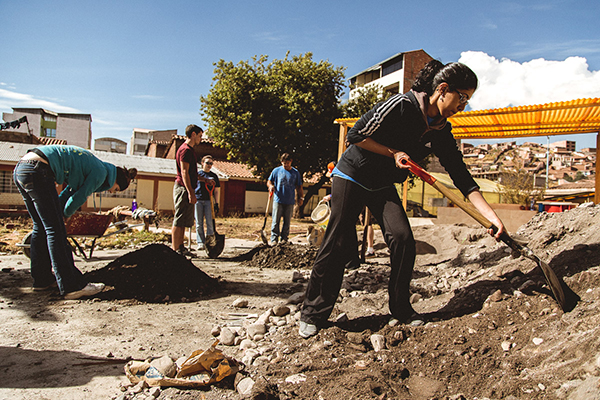
On Safe Homes Movement projects, local architects and engineers lead the design and supervise construction, while community leaders guide volunteers throughout the project. Residents identify the need and work on site in a 50/50 model. Students don't test or design foundations themselves, but they see firsthand how site conditions shape every decision. If you're new to construction, start with these volunteer construction basics.
What students learn on site
- Why engineers inspect the ground before work begins
- How a slope, water and loose soil change the plan
- How professionals explain technical decisions to residents
- Why a well-built structure starts below the surface
You can see these steps on the development service learning trip with Safe Homes Movement, powered by MEDLIFE, in Lima, Cusco and Tena. Trips run in summer, winter and spring, with several days of supervised field work alongside residents and local professionals.
Start where every structure starts
Soil testing for construction is the quiet first step behind every safe build. Seeing it in action, on a real hillside with the people who will use the structure, makes the classroom concept click.
Fill out the form to get dates, eligibility details and next steps for the Development Service Learning Trip.
Frequently asked questions
Why is soil testing important before construction?
Soil testing shows what the ground is made of and how it will behave under a structure. Engineers use the results to choose foundations, design walls and plan drainage, which helps avoid settlement, cracking or slope failures.
What does a soil test for construction include?
It usually combines field exploration, such as test pits or borings, with laboratory tests on soil samples. The specific tests are chosen by geotechnical professionals based on the project and local regulations.
Is soil testing required in Peru?
Peru's National Building Regulations include a technical standard for soils and foundations (E.050), and official guidance stresses the importance of a geotechnical study and professional supervision before building.