


In many neighborhoods around Lima, houses are never really "finished." A family starts with a single room of plywood or reed mats. Years later, they add brick walls, then a concrete floor, then a second story with steel bars left sticking out of the roof, waiting for the next stage. Walk through these hillsides and you'll see homes at every step of incremental housing.
The idea is simple: build a home gradually, as money, time and materials allow. In this article, you will learn what incremental housing is, why it's so common in Lima, what risks come with building without technical support, and how architects, engineers and communities can help families build safer homes, one stage at a time.
What is incremental housing?
Incremental housing describes homes that grow over time instead of being built all at once. Families usually start with basic shelter and expand as their resources grow, adding rooms, upgrading materials and eventually building upward.
Self-built and step by step
In Peru, much of this building is done by families themselves, a practice known as autoconstrucción. A 2024 study by the research group GRADE, reported by Infobae, found that about 69% of homes in Lima and Callao are self-built, and that finishing the first floor can take around 16 years.
A planned strategy in architecture
Architects and urban planners have also used incremental housing as a deliberate design strategy. Instead of delivering a finished house, a project provides a safe core, such as a structure, a bathroom or utility connections, and leaves space for families to expand later. The idea respects how families already build and gives them a stronger starting point.
Why incremental housing is so common in Lima
Migration and land on the hillsides
Over the past decades, families from across Peru moved to Lima seeking work and opportunity. With few affordable options, many built homes on the steep, rocky hillsides at the city's edges. Today, close to a million people live in these settlements.
Building as income allows
Most families can't access a mortgage or pay for a full house at once. Building in stages lets them invest when they can, but it also means homes spend years in a partly built state. You can read more about the housing challenges in Ecuador, where many families face similar barriers.
The risks of building without technical support
Incremental housing gives families control, but building without architects or engineers comes with real risks:
- Unstable ground: many homes sit on loose sand and rock that can shift during earthquakes or heavy rain
- Structural weaknesses: adding floors without proper design can overload walls and foundations
- Lightweight materials: early stages often rely on plywood or reed mats that offer little protection from cold or damp
- Missing services: homes may wait years for water, sewage and electricity connections
| Stage | Common materials | Main risk |
|---|---|---|
| First shelter | Plywood, reed mats | Cold, damp, little protection |
| Upgrading walls and floors | Brick, concrete | Building without technical guidance |
| Adding floors | Concrete, steel | Overloading the original structure |
That's why access to technical support is so important. Our article on affordable housing in underserved communities explains why safe, stable homes matter for long-term success.
How design and community projects can help
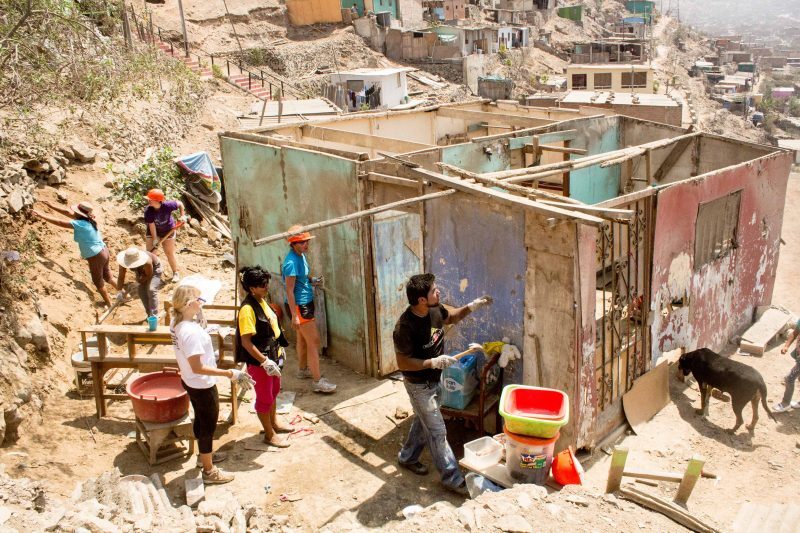
Safe Homes Movement works with families and communities on home construction and renovation, as well as infrastructure such as staircases and retaining walls that make hillside neighborhoods safer. Every project follows a 50/50 model: residents identify the need and work on site, while local architects and engineers lead the design and supervise construction. Learn more about the sustainable house construction practices behind this work.
For architecture, engineering and urban development students, incremental housing is a powerful lesson. It shows how design has to respond to real budgets, real timelines and the way families already build. On the development service learning trip, students join these projects in Lima, Cusco and Tena, working alongside residents and local professionals.
See how homes grow, and help them grow safer
Incremental housing reflects how millions of families build their futures, one stage at a time. Seeing it up close, alongside local professionals and the families themselves, changes how you think about design.
Fill out the form to get dates, eligibility details and next steps for the Development Service Learning Trip.
Frequently asked questions
What is incremental housing?
Incremental housing is the process of building a home gradually over time, adding rooms, upgrading materials and building upward as resources allow.
Why is incremental housing common in Peru?
Many families can't afford to build or buy a complete home at once. A 2024 GRADE study found that about 69% of homes in Lima and Callao are self-built, often in stages over many years.
Is incremental housing safe?
It can be, when families have access to technical guidance. Without it, homes may be built on unstable ground or expanded in ways that weaken the structure.