

Faculty-Led Study Abroad vs Service Learning Trips
If you teach engineering, architecture or development studies, you may be planning to take students abroad. Two formats come up again and again: faculty-led study abroad, where a professor leads a group through a credit-bearing course in another country, and service learning trips, where students work alongside a community on a real project. Both can be powerful. They are not the same thing.
Choosing well starts with your learning goals. In this article, you will learn how faculty-led study abroad typically works, how a service learning trip differs, what each format offers your students, and how some educators combine the two to give students classroom depth and hands-on field experience.
What is faculty-led study abroad?
Faculty-led study abroad is a short-term program designed and led by a professor from the home institution. The group travels together, usually for a few weeks, and the experience is built around a course.
How it usually works
- Academic core: lectures, readings and assignments tied to a specific course
- Site visits: museums, firms, universities, landmarks or field sites related to the subject
- Credit: students typically earn academic credit through the home institution
- Faculty presence: the professor teaches and travels with students throughout
What students gain
Faculty-led programs give students a guided academic look at another country. An architecture course might study historic buildings; an engineering course might visit infrastructure projects. Students learn from their own professor in a new context.
What is a service learning trip?
A service learning trip is built around a community-identified need. Students prepare, work on a project with residents and local professionals, and reflect on what they experienced. The focus is on doing and understanding the work, not on a full academic course.
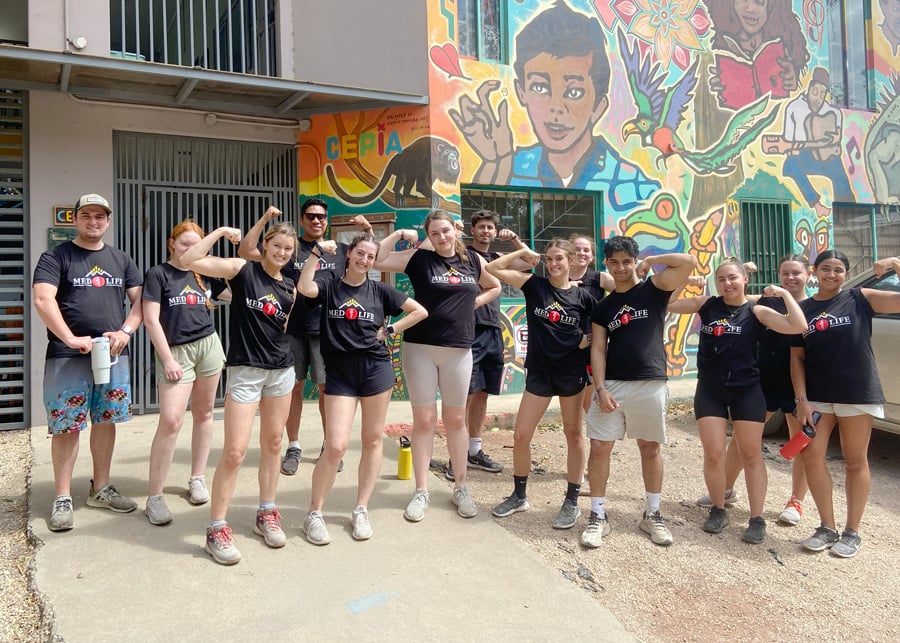
The Development Service Learning Trip from Safe Homes Movement, powered by MEDLIFE, is this kind of experience. It is not a study abroad program and doesn't replace one. Instead, it gives high school and college students about a week in Lima, Cusco or Tena, including four to five days of supervised field work, with trips in summer, winter and spring.
During the trip, students:
- Start with an orientation and a Reality Tour of the communities where Safe Homes works
- Join build days that begin with a brief training session
- Work alongside residents under the guidance of local architects, engineers and community leaders
- Close the project with an inauguration together with the community
Projects follow a 50/50 model: the community identifies the need and works on site, and local professionals lead design and supervise construction.
Faculty-led study abroad vs service learning trips: key differences
| Faculty-led study abroad | Service learning trip | |
|---|---|---|
| Main goal | Deliver course content abroad | Contribute to a community project and learn from it |
| Who leads | Home-institution faculty | Local professionals and partner staff, with group leaders |
| Typical activities | Lectures, site visits, assignments | Orientation, field work, reflection |
| Community role | Often a setting for learning | An active partner that chooses the project |
| Hands-on work | Varies by course | Central to the experience |
| Credit | Usually built in | Depends on the institution |
When each format fits best
Choose faculty-led study abroad when your priority is teaching a specific course in an international setting, with your own syllabus and assessments.
Choose a service learning trip when you want students to see infrastructure and community development from the ground up, and to work with the people who live with the results.
Combining both
Some educators use both formats. A faculty-led course can provide context on urbanization, housing or water in Latin America, while a service learning trip gives students direct field experience. Others add pre-trip readings and post-trip reflection so a service learning trip connects to their curriculum. If you are helping students pick a location, our guide to the best countries to visit for students offers a useful starting point, and learning a few easy Spanish phrases helps students connect on site.
To review destinations, dates and group options, visit the development service learning trip page.
Choose the format that fits your goals
Faculty-led study abroad and service learning trips serve different purposes, and both can be part of a strong global education plan.
If you want your students to gain hands-on field experience with local professionals and communities, fill out the form to get dates, group details and next steps for the Development Service Learning Trip.
Frequently asked questions
What is faculty-led study abroad?
Faculty-led study abroad is a short-term, credit-bearing program designed and led by a professor from the student's home institution, built around a course taught in another country.
Is a service learning trip the same as study abroad?
No. Study abroad centers on academic coursework. A service learning trip centers on a community project, preparation and reflection. Some institutions may connect it to a course, but the format is different.
Can faculty lead a group on a service learning trip?
Yes. Educators often travel with their students as chaperones on service learning trips, while local professionals lead the technical work and partner staff manage logistics on site.