

Construction Materials List for Student Builders
The first day on a construction site can feel like learning a new language. Someone asks for cement, someone else for rebar, and a pile of bricks waits next to sacks of sand. Knowing what each material is, and what it does, makes it much easier to follow instructions and stay safe. A basic construction materials list is one of the most useful things a student can learn before arriving on site.
In this article, you will learn the most common materials used in small-scale community construction, what each one does, how they work together in a structure, and how to talk about them on site, including a few Spanish terms. Every material decision on a real project belongs to qualified professionals, but understanding the basics helps you learn faster.
A basic construction materials list
| Material | What it is | What it's used for |
|---|---|---|
| Cement | A fine powder that binds other materials when mixed with water | An ingredient in concrete and mortar |
| Sand | Fine aggregate | Mixed into mortar and concrete |
| Gravel or crushed stone | Coarse aggregate | Mixed into concrete for strength and volume |
| Concrete | Cement, water and aggregates that harden together | Foundations, floors, columns, stairs |
| Mortar | Cement, sand, water and sometimes lime | Bonding bricks or blocks together |
| Bricks and blocks | Masonry units of clay or concrete | Walls |
| Steel reinforcement (rebar) | Steel bars placed inside concrete | Helping concrete resist tension |
| Wood | Timber boards and beams | Formwork, frames and some structures |
Cement is not concrete
One of the most common mix-ups is calling a sidewalk "cement." Cement is only one ingredient. As the CCAGC explains, concrete combines aggregates with a paste of cement and water. Mortar uses cement too, but it's designed to bond masonry units rather than to form structural elements on its own.
Why concrete needs steel
Concrete handles compression well, but it is weak in tension. Civil engineer Grady Hillhouse explains at Practical Engineering that steel reinforcement is added so concrete elements can carry tension. That's why you'll see rebar placed before concrete is poured in many structures.
How the materials work together
A small structure usually combines several items on this list. Foundations and columns may use concrete with steel reinforcement, walls may use bricks or blocks bonded with mortar, and wood often forms temporary molds, called formwork, that hold fresh concrete in shape until it hardens. The exact combination always depends on the design.
How these materials are used in Peru
What homes are made of
Peru's 2017 census gives a useful snapshot. According to INEI, 55.8% of occupied private homes with residents present had exterior walls made mainly of brick or cement block, and 27.9% of adobe or tapia (rammed earth) combined. The rest used other materials.
Traditional materials still matter
Earth, cane and wood have long histories in Peruvian construction. Our article on traditional architecture in Peru looks at how these traditions continue to shape the built environment.
Talking about materials on site
A few useful Spanish terms
- Cemento: cement
- Arena: sand
- Piedra or grava: stone or gravel
- Ladrillo: brick
- Acero de refuerzo: steel reinforcement (on many sites you'll also hear the local terms fierro or varilla)
- Mezcla: mix
For more vocabulary, read our practical guide in Spanish for volunteers.
Safety comes with every material
Cement can irritate skin and eyes, bags and blocks are heavy, and steel bars have sharp ends. Follow the instructions of the local team, wear the safety equipment provided, and ask before you lift, cut or mix anything.
Who decides what to use
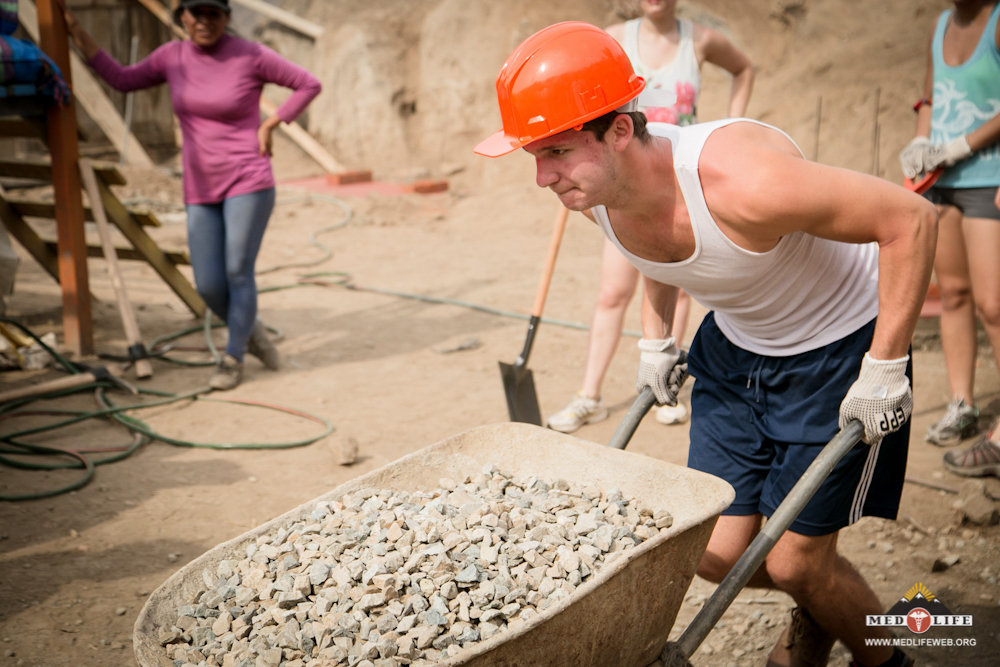
On Safe Homes Movement projects, local architects and engineers choose materials, set the proportions and supervise construction, while community leaders guide volunteers throughout the project. Residents work on site in a 50/50 model. Students help with tasks like mixing cement and laying bricks, learning how each material contributes to the final structure. Read more about construction volunteering abroad and what to expect.
You can put this construction materials list to use on the development service learning trip with Safe Homes Movement, powered by MEDLIFE, in Lima, Cusco and Tena. Trips run in summer, winter and spring, and safety equipment is included.
Learn the materials by using them
A construction materials list becomes real when you see each material in someone's hands, building something a community will use every day.
Fill out the form to get dates, eligibility details and next steps for the Development Service Learning Trip.
Frequently asked questions
What are the basic construction materials?
Common basics include cement, sand, gravel, concrete, mortar, bricks or blocks, steel reinforcement and wood. Each plays a different role, from bonding to carrying loads.
What is the difference between cement, concrete and mortar?
Cement is an ingredient. Concrete combines cement, water and aggregates such as sand and gravel. Mortar combines cement, sand, water and sometimes lime, and is used to bond bricks or blocks.
Do student volunteers choose construction materials?
No. On supervised projects, local architects and engineers choose materials and proportions, and volunteers work under their guidance and that of community leaders.